
At the 104th ARTCaffè, guest speaker Eunsaem Ahn shared an intimate reflection on her artistic practice across painting, collage, and drawing. She described her long-standing interest in how forms—lines, colours, angles, and surfaces—relate to one another through notions of weight, balance, and order. By assigning “weights” to visual elements, working with numerical systems, and creating template-like images, she explores how intuitive sensation and structured thinking coexist. Moving between large bodily gestures and minute adjustments, Ahn views her work as an ongoing attempt to understand equilibrium—both within artworks and in the world itself.
Below is a recap of The Talk.
***
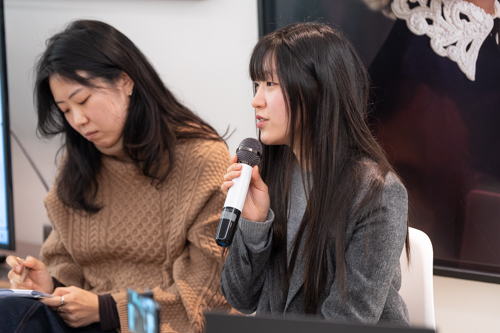
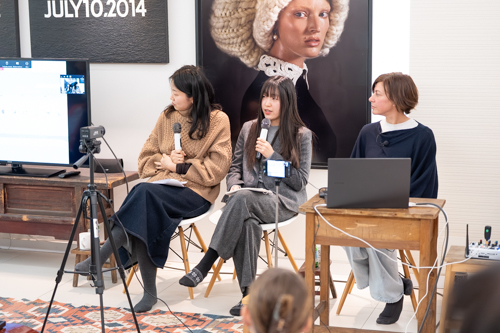
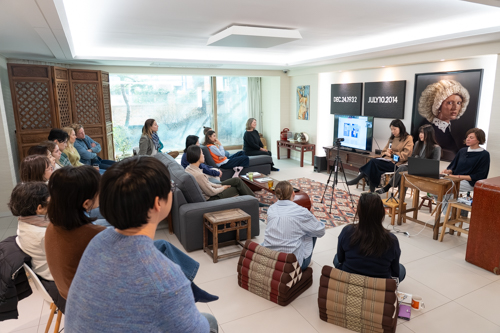
Eunsaem Ahn: I am an artist working in painting and collage. While preparing this presentation, I revisited my work from its earliest stages. Through this process, I realized that, despite exploring various methods across different media, my work ultimately converges on a common concern. I would like to share with you the visual outcomes of that journey.
When we look at a landscape, its appearance feels natural and self-evident. Yet, if we strip away meaning and symbolism and trace only its outlines, the scene becomes an overlay of strange and unfamiliar lines.
The degree to which a curve bends, the length and proportion of a straight line, whether squares are perfect squares or rectangles—these differences conveyed distinctly nuanced sensations to me. I explored these subtle variations in form within my paintings.
When I first began painting in earnest, I would recognize the forms I discovered along an object’s outline as patterns and paint accordingly. At that time, I was more interested in how the subject looked and what kinds of formal rules it possessed than in the subject itself or its meaning.
I was particularly interested in the starting points of early geometric abstractionists such as Kandinsky, Mondrian, and Malevich, and I was also influenced by their approach to abstracting reality and their tendency to view abstraction and the spiritual as interconnected.
After producing many works, both large and small, I found myself re-evaluating my approach to painting when I held a solo exhibition featuring oil paintings.
At that time, I used a variety of tools when painting, such as rollers, spatulas, squeeze bottles, rulers, and compasses. I found myself distinguishing which tool to use and how to draw each line. For instance, some lines required thick application, made by dipping the ruler in paint, while others demanded a breathy, almost hesitant touch. Still others required swift execution. This depended largely on the line’s position and what lay beside it.
I gathered the lines used in the painting. The first line was made with a short spatula, and the second was neatly traced with masking tape. If you draw quickly along a ruler or dab paint onto the ruler to create a line, you obtain a different result. When I moved these resulting pieces around, it felt as though each had its own designated place. I became curious about why this difference in feeling occurred.
I began to consider whether other senses might convey this sensation, and to me it felt akin to a sense of weight. Thick, dense lines feel heavy, while pale, swiftly drawn lines feel light. Heavy lines, to me, are crucial ones, capable of bearing the weight of their assigned surface, whereas other lines flow lightly and serve a supporting role.
I believed this order could apply not only to lines but to other elements as well. There were colours I frequently used for backgrounds, and colours that took on the role of protagonists. In terms of angles, acute angles felt heavier to me than obtuseones. Squares took precedence over rectangles, lines over surfaces, and bundles over single elements.
While organising these charts, I realised that although I fundamentally enjoy drawing freely, I also find myself continually viewing the characteristics of form through a numerical lens. Here, “numerical” refers less to mathematics and more to the act of listing, counting, and continually seeking patterns within that process. Reflecting on the drawings I had made over time, I created what I call “Weight Drawings.” I separated each element within an image, listed them from lightest to heaviest, and assigned the unit ‘g’ (grams) to each element, giving them individual weights. When all these weights are added together, the total weight of a single picture emerges.
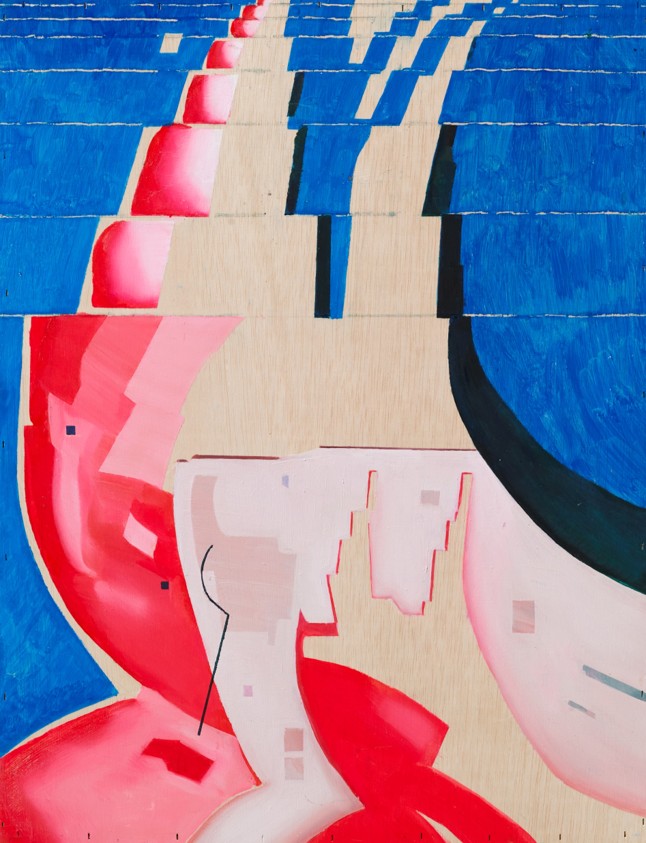
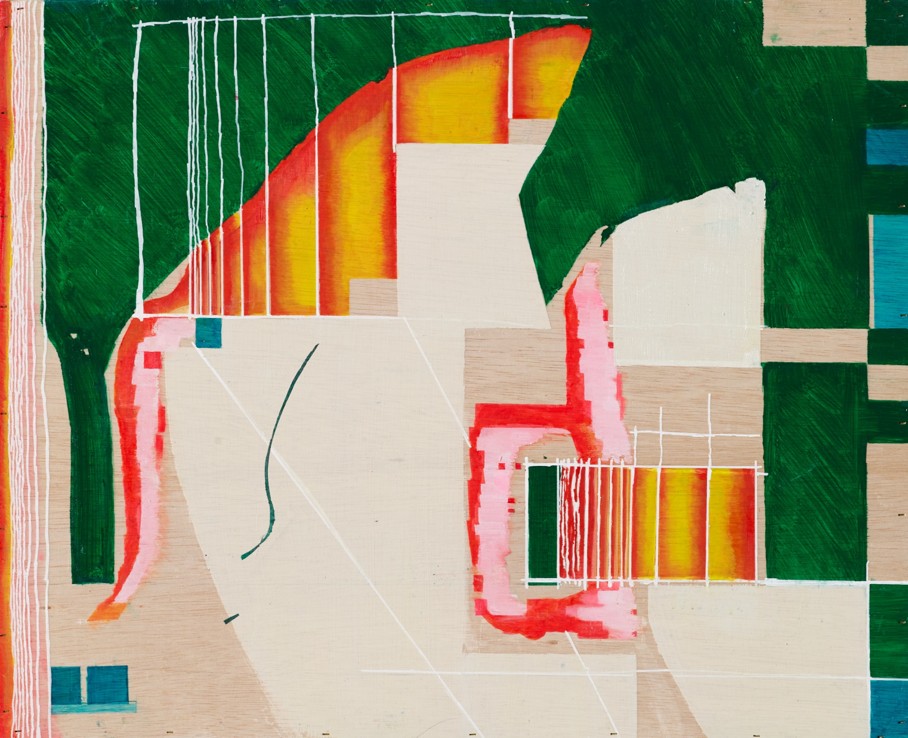
For instance, in the painting titled 315g, I disassembled every element within the image. I then set the lightest element at 1g and calculated the weight of the other elements relative to it. The resulting image is 315g Descending Order. This weight, therefore, is not a physical or directly measured one. It varies depending on the colour, surface, thickness, and position of the elements composing the image. I considered this “arbitrary result” to be a unique order inherent to the image, distinct from the sensibilities of mathematics or science. I personally refer to painting like 315g Descending Order as “template painting”—it exists as another image that explains the original painting. I enjoy creating these kinds of “instruction manual”–style illustrations for paintings. While this differs from the traditional way of viewing art, for me it is one way of repeatedly studying a single painting.
Next, I extracted all the colours used in 315g and created an image by converting them into complementary colours. This could be described as an image composed of the colours I use the least, and assembling all these elements together resulted in 274g.
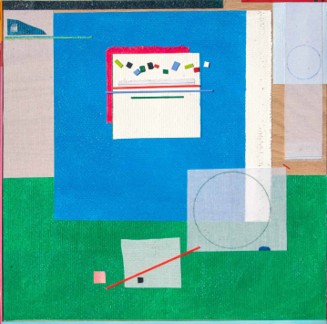
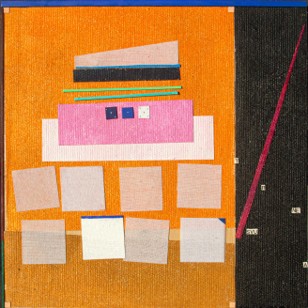
After that, I began actively creating collages. Collage is more useful than painting for immediately transferring and attaching surfaces. While painting fills the canvas through the act of drawing, I wanted to create images through the assembly of appropriate lines and colours. Initially, I made these works by attaching thin pieces of wood and plastic fabric.
This brought me to my second solo exhibition, which was primarily a collage show titled Shifting Three Centimetres.
Three centimetres is roughly equivalent to one inch. When I previously painted, I used my entire body, moving in units of metres. This work signifies movement in a much smaller unit.
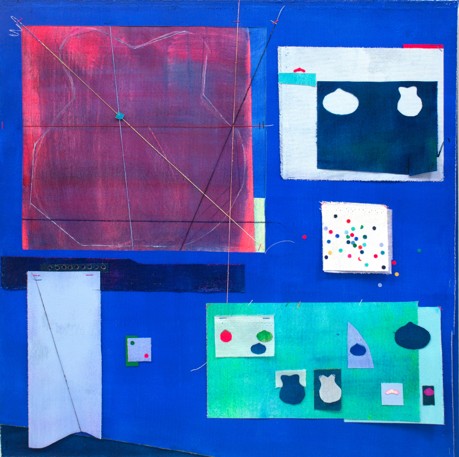
I created small collage paintings, incorporating characteristics of power and weight that can be conveyed through form. The sharpness derived from acute angles, squares with a sense of rhythm, numbers and repetition based on calendars—I captured these characteristics, which I sensed and which had continued from my earlier paintings, within the artwork.
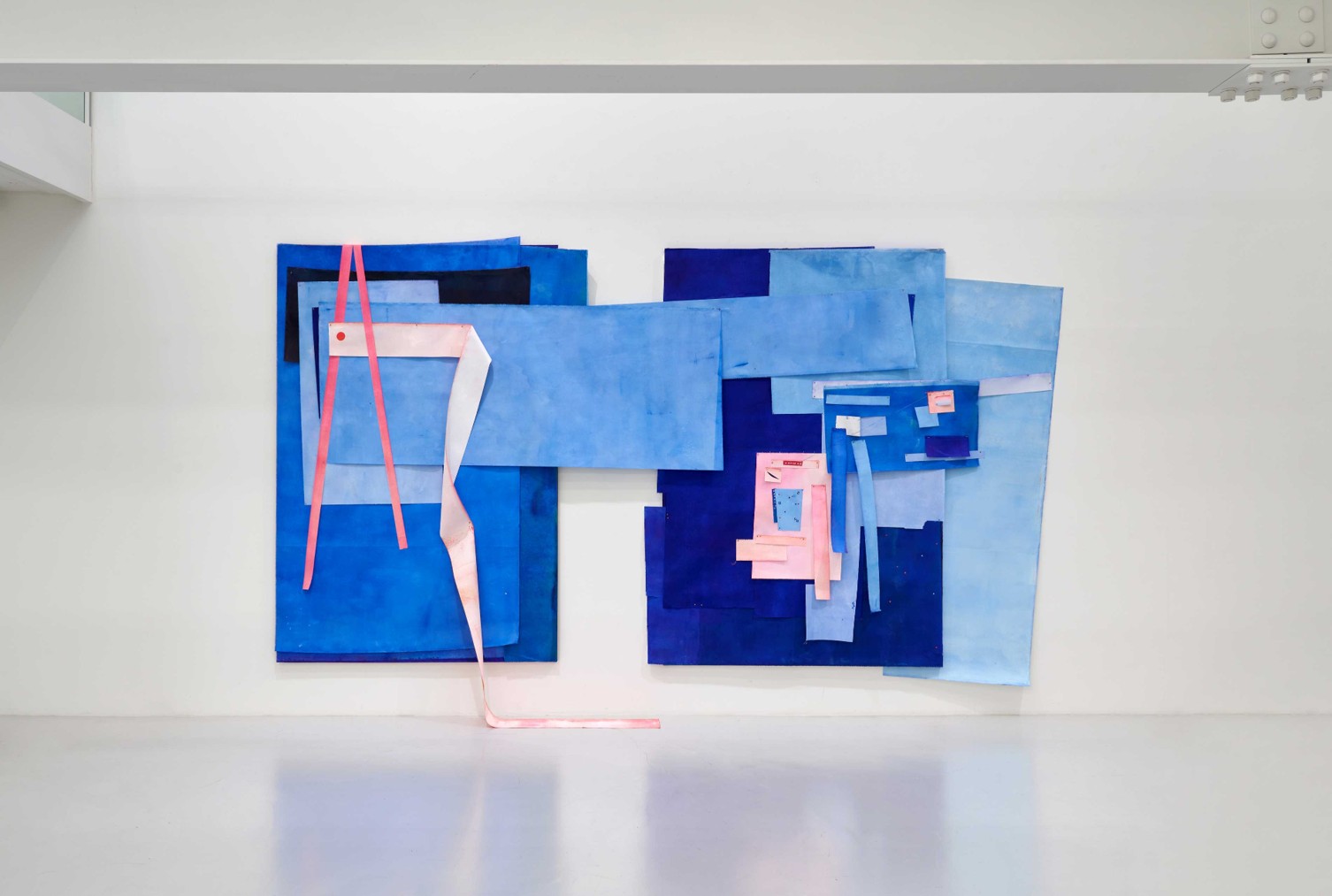
Subsequently, I began creating collages on a slightly larger scale. Sum of blue consists of two pieces forming a pair. The left image was created with the intention of adding colours within the blue hue, and elements from that image were then reintroduced to produce the right image, achieving the same result at identical dimensions.
Sum of blue and pink also explores the potential for expanding collage further. It was exhibited in last year’s Gallery SP trio show. At that time, I hung the collage on a large wall with a ceiling height exceeding three meters. Rather than attaching the elements beforehand, I brought them to the site and assembled them during the installation.
Through this installation process, the surfaces that had been fixed to the frame became more variable, allowing elements that had once been part of the painting to become complete images in their own right.
I would now like to talk about drawing. There was a time when I used to draw quite frequently. Perhaps because painting or collage requires planning before one begins, I consider them somewhat more social or official media. Drawing, on the other hand, feels like a much more private medium to me. When I draw, my thoughts naturally become organised, and at times it feels very much like writing in a diary.
At one point, I collected outlines of various places. I found it fascinating how outlines alone could suggest the atmosphere of a location, and how they produced a fairy-tale-like feeling. These places included the Hantan River in Gangwon-do, a garden from a video game I played, a fairy-tale village in Incheon, and an indoor gymnasium I saw in a dream. I collected them using colours and layouts suited to each place.
These drawings were ones I sketched daily, one or two at a time, like entries in a diary, capturing my emotions and everyday life at the time. Whereas the works I mentioned earlier were more directly about art, these drawings contain a greater presence of reality and the world around us. The shifting dynamics found in games like tag or dice, the speed of snowflakes falling from the sky, the rhythm of breath held and released while swimming—I realised that these elements are not fundamentally different from the relationships of force within the elements I draw.
I am seeking ways to convey and metaphorically represent the shifts in power and weight I observe in art, while recognising that these do not exist solely within the realm of art. I find that my pursuit of balance and harmony within my paintings ultimately mirrors how the world itself operates. For this reason, I am researching phenomena and objects in reality that can express this idea.
I collected shells from various beaches along the East Sea. As I observed them, I noticed a lineage in their shapes. For example, the reddish-brown shells, though varying in size, are all circular, while the shells with patterns on a white background share a broad, horizontal form.
I found it fascinating that even these small shells possess a lineage of form, and I felt that metaphors for living beings could be found at such a minute scale. This led me to create a collage inspired by the image of shells arranged in a specimen box.
Based on my belief that certain principles and laws govern the objects around me, I began to observe them more closely. For instance, I attempted to categorise the forms of blades of grass on a lawn, or to derive architectural principles from the wooden block toys that young children play with. I assigned numbers to the grass in order of lightness according to form and colour, and then created a lawn in which those numbers gathered in place of the grass itself. I also built a castle and a bridge using wooden blocks I played with as a child. This process reflects how small units accumulate to form a structure.
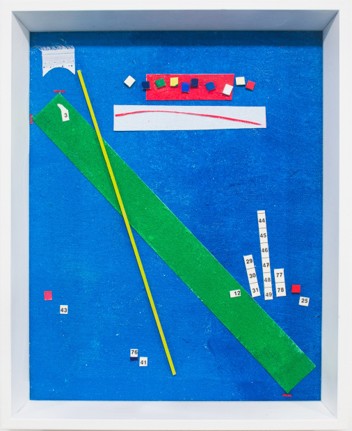
Finally, The day it snowed is part of a series I have been developing recently—a collage that links dates recorded in a calendar with puzzle games. The numbers are based on actual past dates when it snowed, and this nonogram puzzle is designed to reveal a snowy landscape. It seems to me that this kind of record could become another way of containing order. Recently, I have also developed an interest in conceptual artists who work with numbers and records as their themes, and I am studying their practices while continuing to develop this work.
Through my practice, I have observed countless relationships that support one another as they oscillate between heaviness and lightness, continually seeking equilibrium. Within this process, the orders I create are, I believe, less complete answers and more like attempts. Yet the very act of continuously shifting, adjusting, attaching, and detaching remains a source of joy for me, and it is what ultimately drives me to paint.
"I am seeking ways to convey and metaphorically represent the shifts in power and weight I observe in art, while recognising that these do not exist solely within the realm of art. I find that my pursuit of balance and harmony within my paintings ultimately mirrors how the world itself operates. For this reason, I am researching phenomena and objects in reality that can express this idea."
All the pictures from The Talk's presentation are courtesy of the artist.
Thanks to those who joined in person and online, and to the many connecting nodes who actively helped spread the word about this event. Special thanks to Jaewon Yang for the translation, and to curator Kichan Yang and Gallery SP for creating the connection and making this event possible.

