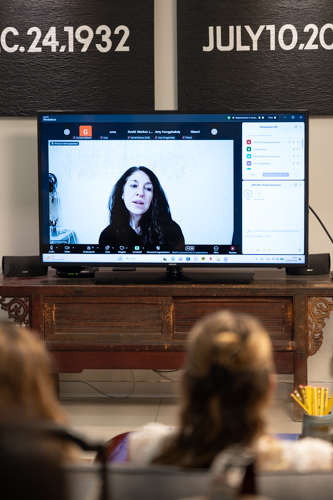
In this thought-provoking talk at the 103rd ARTCaffè, Annabel Daou traces her practice through the lens of me and you, us and them, here and now, exploring language, sound, intimacy, and community. Drawing on projects from 2011 to the present, she discusses participatory works that collect voices, gestures, worries, and responses—often from strangers—to examine trust, context, and shared experience. From fortune-telling performances and public billboards to installations shaped by war, protest, and the pandemic, Daou reflects on how art can hold personal and collective histories, and how being together, even briefly, leaves a lasting residue.
Below is a recap of The Talk.
***
Annabel Daou: I’m going to run through my work based on the title of this talk, Me and You, Us and Them, Here and Now.
My work has a lot to do with language, with sound, and with being here together now. I’m really interested in context—in how we find ourselves together, and in what the residue of that is, in a way. For me, language, and the collecting of people’s responses, is one of the ways I feel I can express what being in community means to me.
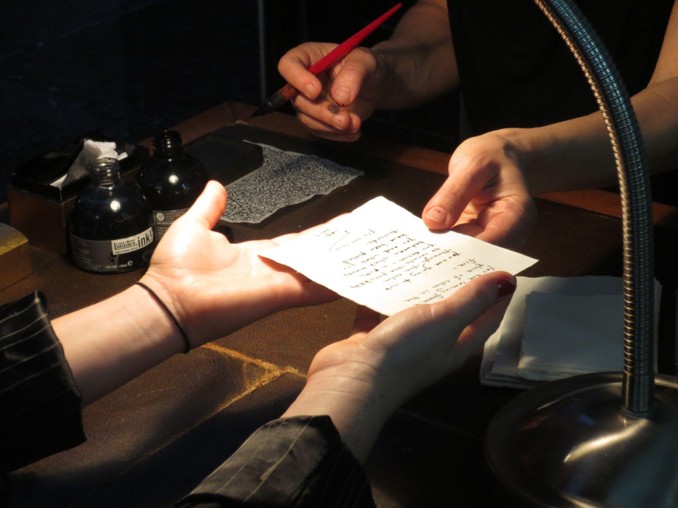
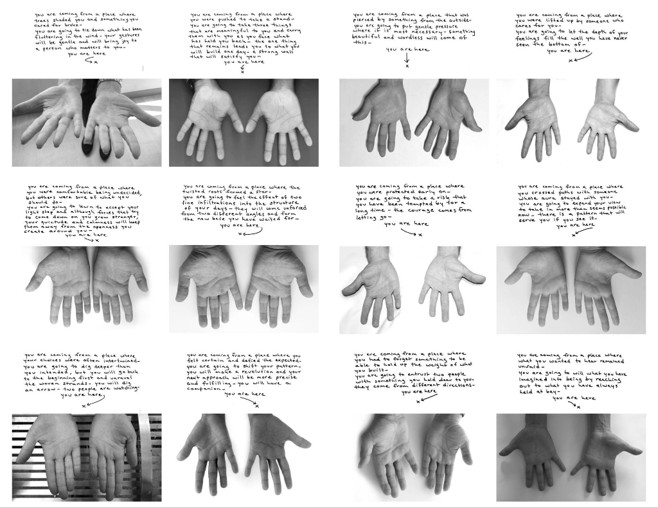
I’m going to begin with a project that started in 2013. It’s called Fortune, it’s ongoing, and I’ve been doing it in numerous places since then. It really began when I moved to America from Lebanon at the age of 18. One day in my dorm, I pretended that I knew how to read fortunes, because I felt like such an outsider at the time. Everybody was really into it. Years later, I started thinking about that experience, and about what fortune telling is. I realized there’s a kind of metaphor there for being an artist. The artist is, in some way, hawking their wares. You put your hands out because, in a way, you want something from them. There’s intimacy, expectation, exchange. There’s also this idea that the artist might have some capacity to see the future, or to see through things.
So I decided to become a fortune teller as a kind of performance. But since it involved labor, I decided to charge for it, like an actual fortune teller. It began in 2013 at PS1. I publicized it, and I had a sign that said, “Sit down, put out your hands, and be quiet.” The work is entirely silent. I read one line of text for each line in the person’s hands, and then they pay me and I hand them the paper.
Part of what interested me was the idea that I’m making a work for you and about you. At the same time, it’s also about making a work for anybody and everybody. People are still paying me, but the price point makes it possible for the work to exist in the world for anyone. In a sense, they’re buying a work by me that’s made specifically for them. There’s something very quiet about it, because I don’t speak and I don’t allow others to speak. People are simply reading the text they’re handed. They may not fully understand it, but they’re left to read it in whatever way they do.
Fortune telling is illegal in many religions, and it so in New York. You can be a psychic, but not a fortune teller, because fortune tellers can be scam artists—which I find really interesting. There’s a very skeezy, street-like aspect to it. You’re soliciting, in a way.
It’s also interesting to do this work in museums and galleries, especially with very wealthy collectors who don’t carry ten dollars with them and who are often a little suspicious. And yet, what I love about the fortune-telling model is that even people who are deeply skeptical still somehow believe that this stranger—someone on the street asking them for money—might tell them whether they’ll live or die, get married, or have children. The most intimate aspects of their lives. There’s suspicion, but there’s also a breakdown and an opening of trust and intimacy.
I’ve done Fortune in the context of my own exhibitions and in many different places, sometimes art spaces and sometimes not. The one time I did it through photographs was for a public art project in Lebanon, working with a group called Temporary Art Platform. Each artist collaborated with a different newspaper. For my project, I placed an ad in the paper one week that said, “Send me your hands and I’ll write your fortune.” People sent images of their hands, and I wrote their fortunes anonymously. Everything remains anonymous, because I don’t speak and I don’t look. The following week, they printed the work as a double-page spread in the newspaper, so readers could find their own hands and find their fortune.
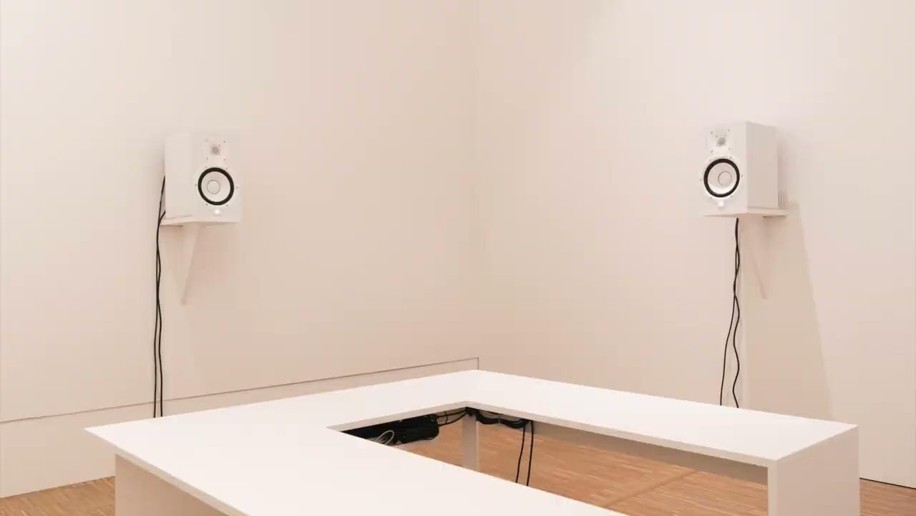
In 2022, I was invited to take part in a show at a museum in Munich called In Search of the Miraculous. I reached out to people through email, open calls, and Instagram—strangers, friends, and friends of friends. I asked them a single question: What do you forgive yourself for? They sent their responses in writing, and I read them aloud. The installation had three speakers, all playing the same audio.
What was most striking to me was the trust people gave me. I find that to be true of many of the works I make. People know that others are participating, and they know that what they share will be held among other people’s contributions. When I voice the responses, it becomes an equalizing act. Sometimes I record people’s voices, but in this case, they sent their words in writing and I read them myself. The piece is about nine minutes long, and people went quite far. They became very intimate, and there’s something deeply beautiful and trusting in that.
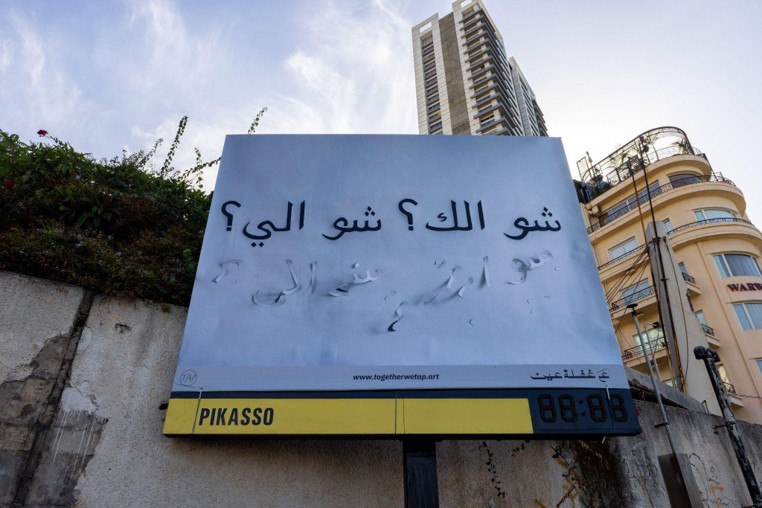
The third project I want to talk about, in relation to me and you, is a billboard project in Lebanon, produced by the same public art foundation. The text reads: What is yours? What is mine? This was in 2024. I was invited, along with ten other artists, to create billboards across Beirut, and I chose to place mine last, in early September 2024.
I was thinking a lot about what was happening in Gaza—I couldn’t get it out of my mind. I also grew up during the war in Lebanon, so war is very much part of my identity. I was thinking about Lebanon more broadly: its factions, religions, class structures, capitalism, and questions of ownership. I decided simply to pose that question, so that people driving by would ask themselves: What is yours? What is mine? What became interesting to me is that when you really sit with that question, it’s very difficult to answer.
I made the billboard by cutting and reassembling the billboard material itself. It appears three-dimensional, but it’s actually flat. The sense of hollowness is artificial, like billboards themselves. The work was meant to go up in the first week of September, and I was supposed to travel to Lebanon to see it. That was when Israel began bombing Lebanon. It was devastating. What was incredible was that the people running the organization found time between the shelling to install the piece. It went up in the middle of the bombing. This image is especially meaningful to me, because I grew up not far from that location.
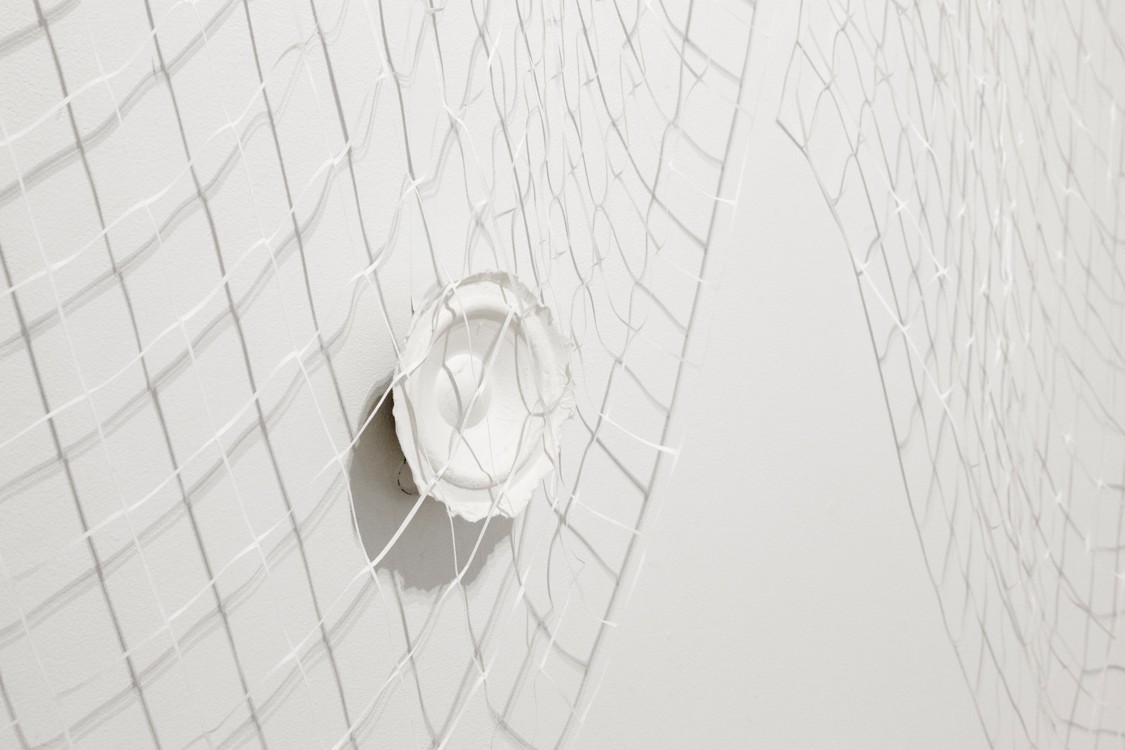
I kept returning to the question what is yours, what is mine, and to what it could really mean. For a show in Dallas in 2025, titled As If They Were Sure to Find Their Way, I continued working with this idea. I cut very thin microfiber paper into six hanging forms. I’m not sure what they are—rib cages, bodies, bones—but they’re extremely soft. The text reads:
My memories / your memories
My struggle / your struggle
My shadow / your shadow
My dreams / your dreams
My silence / your silence
My freedom / your freedom
The language is gridded through the paper. It’s extremely thin and fragile, even though the paper itself is quite strong.
I’ll now move to us and them—to what happens when me and you become us and them, and how meaning shifts.
When there is me, there is individuality. When it becomes us, there is power and shared experience. And when you becomes them, it becomes the other. I’m using this framework to talk about the political dimension of my work and about power.
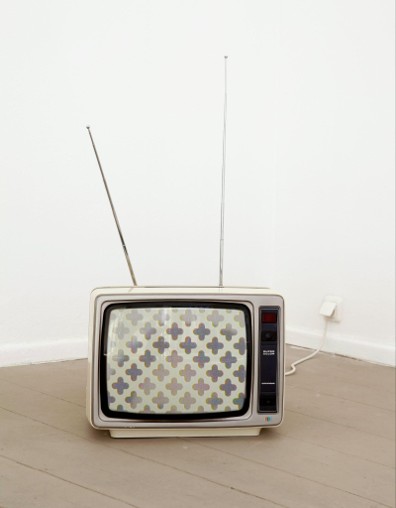
In 2011, I bought an old television and walked through the streets of New York asking people, “Which side are you on?” By the time I actually carried out the project, Occupy Wall Street was happening. After it ended, people began answering the same question in completely different ways—for example, by talking about football teams. Context changes the question very quickly. The work is a sculpture: a television with my face barely visible behind a confessional screen, playing audio of people’s responses.
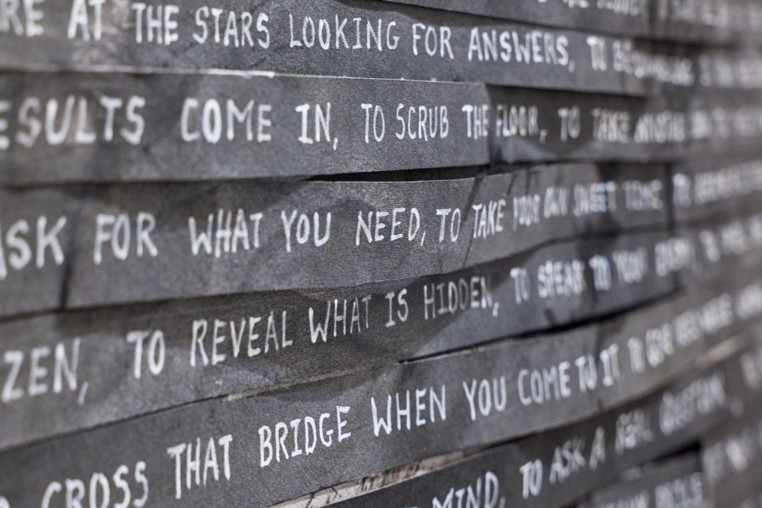
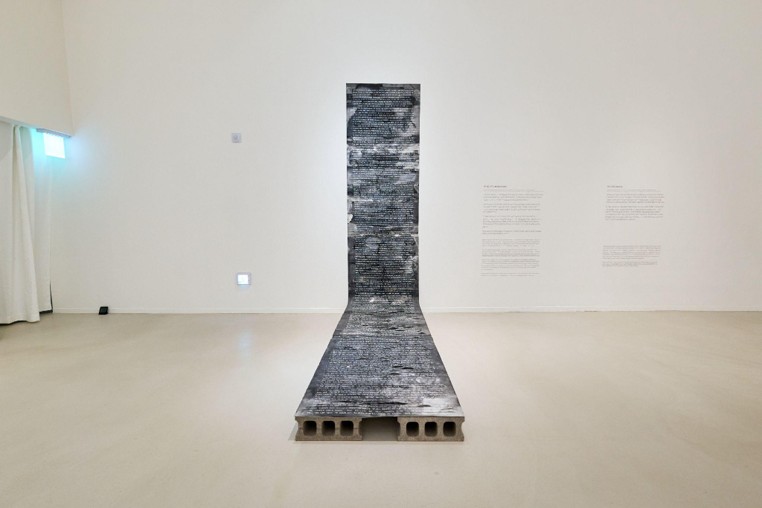
When in the Course of Human Events is a piece currently on view at the PODO Museum in Jeju. In 2019, people were in the streets in Lebanon, Chile, and Hong Kong. I was thinking about the U.S. Declaration of Independence and its opening phrase. I asked people to complete it, and I transcribed their responses onto microfiber paper in the form of a long scroll. There is also an audio version called Declaration, in which I read the entire text in the first person, overlaid with sounds from protests and from my daily life in New York.
The work was installed in January 2020. I had made it thinking that people were in the streets and that this would never change. How could I have known? By the time the exhibition closed, the streets were empty. It was the beginning of COVID.
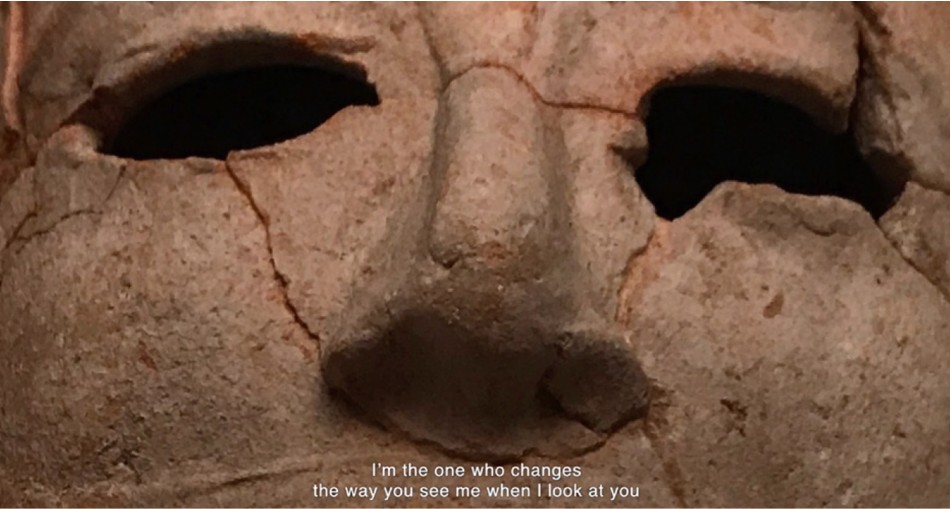
Jumping now to another public art project in Lebanon: I was invited to work in the National Museum, which had stood on the Green Line during the war. Many people had never entered it. We brought people from all walks of life into the museum and invited them to speak for the objects, entirely in Arabic. This became the project Chou Hayda—What Is This? The audio guide was made by the people, for the people. Visitors now move through the museum guided by the voices of others.
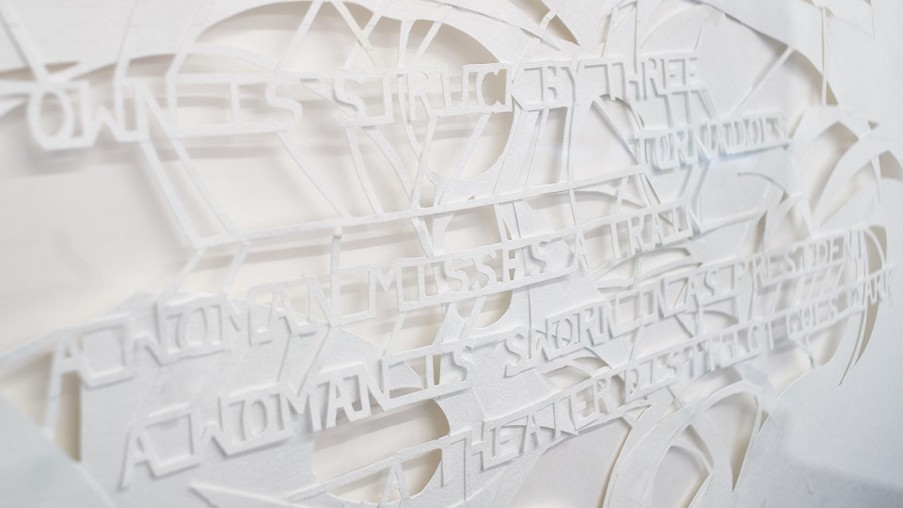
Thinking about here and now, the piece A Year Like Any Other (2020) chronicles every day of the year. I wrote one sentence per day, each beginning with “A,” so nothing is specified. Personal and global events sit side by side. We often say “a year like no other,” but something happens every single day.
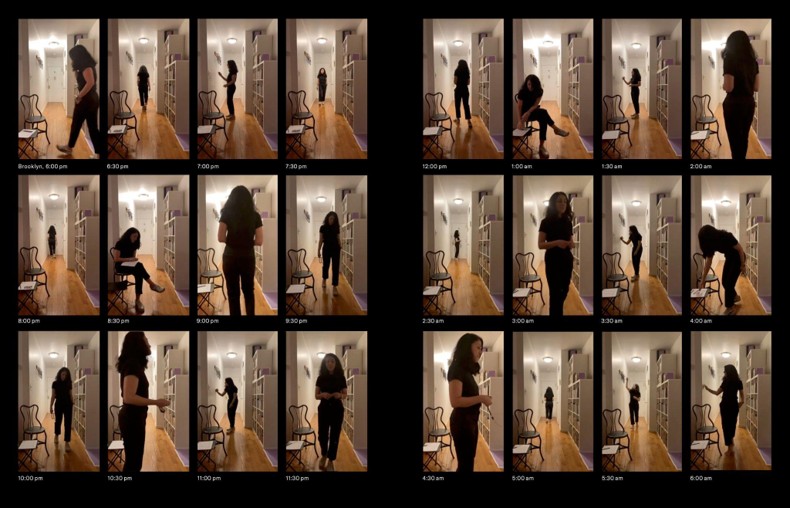
For I Will Worry for You from Dusk till Dawn, I made symbolic worry beads out of paper. I had planned a relay, but COVID made that impossible, so I walked alone for twelve hours, worrying for other people. I was silent, but people knew I was carrying their worry. I was thinking about how we might shoulder each other’s burdens, even briefly.
I’ll end with What’s Left of Us, a collaboration with sound artist Fritjof Mangerich. We asked people to respond to a simple question: What’s left of us?
I often ask strangers questions like these. They don’t know who I am, and the questions themselves are simple. I’m just trying to open a moment in which we can be together, aware of our shared humanity.

My work has a lot to do with language, with sound, and with being here together now. I’m really interested in context — in how we find ourselves together and what the residue of that is, in a way. For me, language, and the collecting of people’s responses, is one of the ways I feel I can express what being in community means to me.
I often ask strangers these questions. They don’t know who I am, and the questions are simple. I’m just trying to open a moment where we can be together, aware of our shared humanity.
All the pictures from The Talk's presentation are courtesy of the artist.
Thanks to those who joined in person and online, and to the many connecting nodes who actively helped spread the word about this event.