
In this engaging talk at the 102nd ARTCaffè, Nicholas Bonner offers a rare inside look at North Korean art, exploring how artists are trained, what they produce, and the complex relationship between ideology, collective identity, and individual expression. Moving from official studio practices to intimate, privately made works, Bonner reveals the coexistence of state-driven socialist realism and unexpected moments of personal creativity. Through anecdotes from decades of visits and collaborations, he highlights both the constraints and the humanity embedded in these artworks, inviting us to reconsider our assumptions about authorship, authenticity, and the role of art within a tightly controlled society.
Below is a recap of The Talk.
***
Nicholas Bonner: In North Korea, children grow up immersed in a visual world that revolves around the country’s leadership. From an early age, they’re taught the significance of places like Mangyongdae, the birthplace of Kim Il-sung, and the narratives that surround them. These locations are presented not simply as historical sites but as foundational elements of national identity, reinforced through constant repetition in education and public life.
The same is true for the mythology surrounding Kim Jong Il’s supposed birthplace near Mount Paektu. This landscape — the mountain, the lake, the “secret camp” — forms part of a larger storyline in which the leaders and their families are depicted as heroic guerrilla fighters resisting Japanese occupation before 1945. Such images are omnipresent: in schools, cultural institutions, sports facilities, and newly built residential areas. Over time, the official portraits have shifted in style, moving from more austere early versions to the friendlier, almost cheerful ones that appeared after 2010.
This visual language extends into the country’s major performances as well. At the Mass Games — one of the events we documented in the film A State of Mind — thousands of children work in perfect coordination, holding card books that collectively form enormous images celebrating the leadership and the revolution. The discipline is intense: whenever the leader’s face appears in the tableau, performers instinctively tighten their formation to eliminate any gaps. Even in such vast spectacles, the hierarchy of imagery is carefully maintained, with the leader’s representation always rendered flawlessly, surrounded by disciplined bodies striving to match its perfection.
Alongside the cult of leadership, another fundamental theme in North Korean visual culture is the country’s historical trajectory: the experience of Japanese occupation, the division of the peninsula in 1945, and the aftermath of the Korean War (1950–53), which entrenched the notion of two enduring “enemies.” Before liberation, the enemy was Japan; after the war, it became South Korea —portrayed as a “spy camp” — and, of course, the United States. Anti-American imagery remains deeply embedded in popular culture, visible in magazines, children’s attractions, and public displays, where caricatured depictions of Americans appear as standard fare.
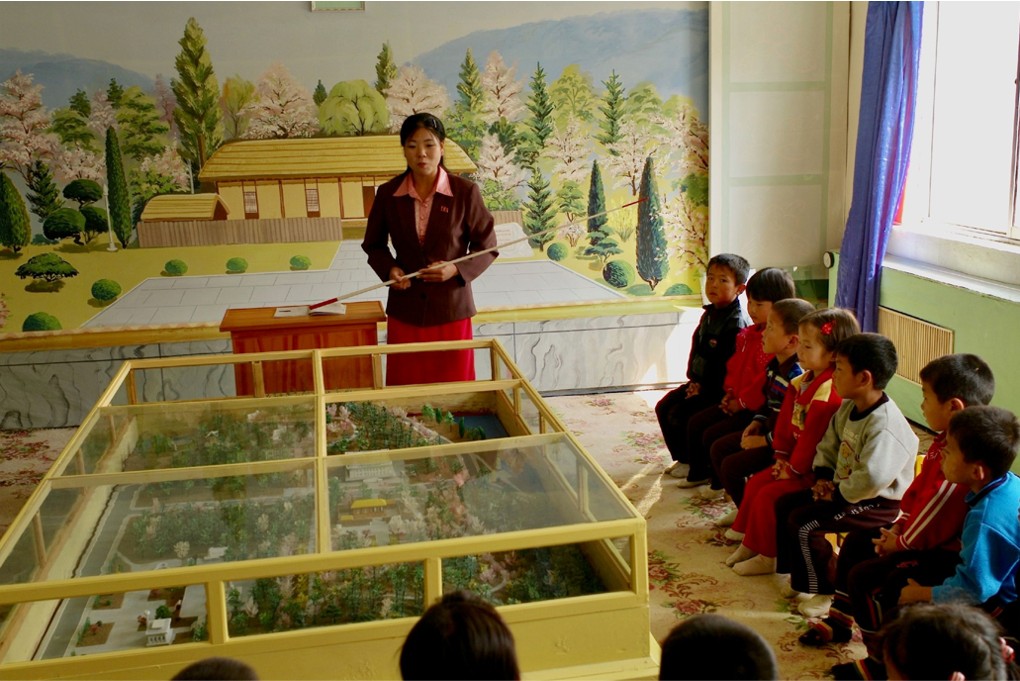
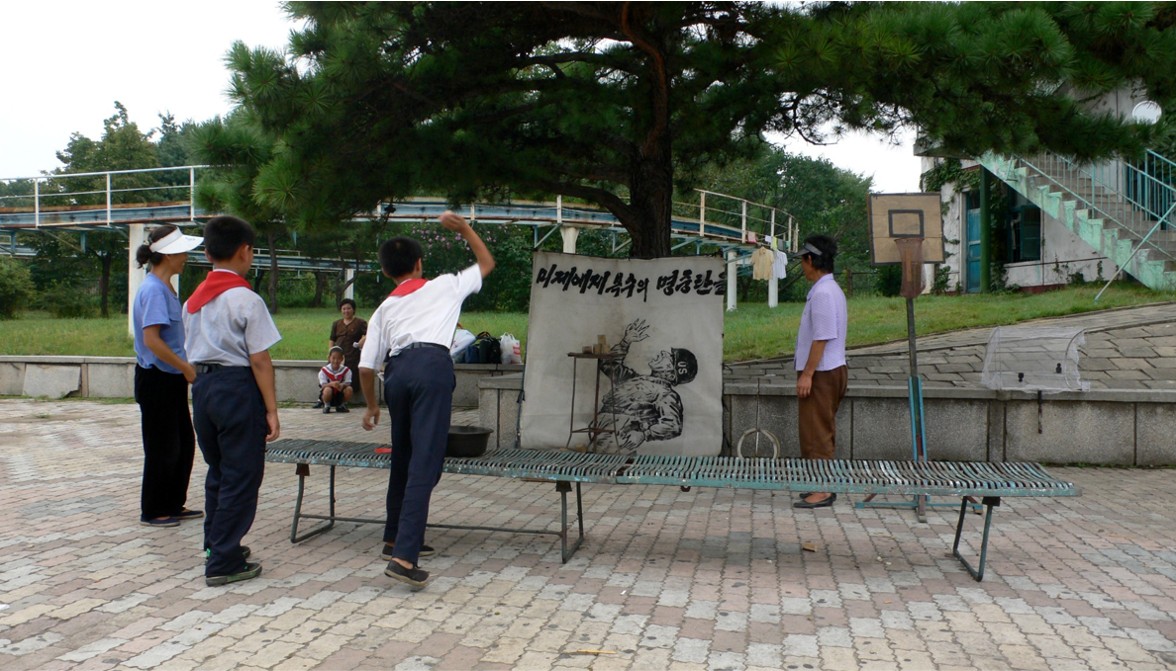
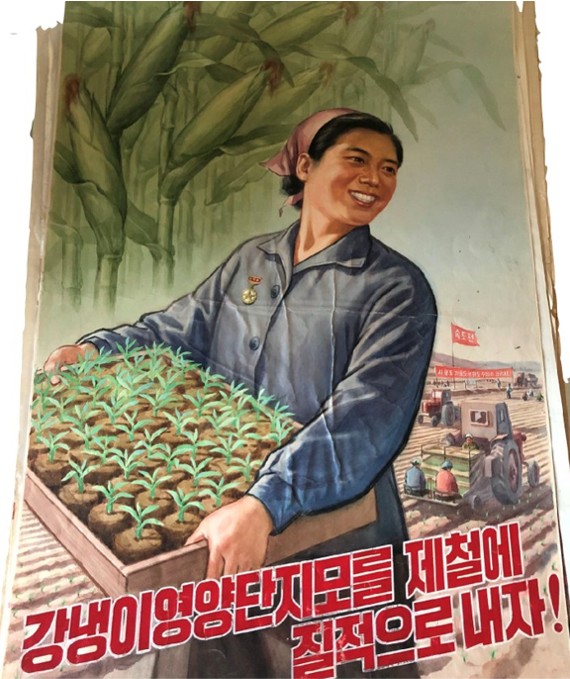
Propaganda becomes even more explicit in poster art. Early posters from the 1950s show simple, almost primitive facial features influenced by Soviet-era aesthetics. Over the decades, the style became more painterly and sophisticated, but the purpose never changed: posters are not considered fine art in North Korea. They are tools of communication, designed to disseminate political messages, mobilize workers, or warn citizens of exterior threats. They appear in various spaced from shops to workplaces. On the streets, they were traditionally hand-painted in sections, and pasted onto billboards often illuminated at night. In Pyongyang the majority of posters are now digitally printed. At larger events or state occasions, these visuals scale up to monumental dimensions.
Beyond posters, propaganda takes more nuanced artistic forms. Sculpture is a key example: monumental works outside institutions like the War Museum blend historical narrative with heroic realism, merging art and ideology in one powerful statement. Similar themes appear in linocuts and ink paintings, which depict scenes from the anti-Japanese struggle and the Korean War, often using recurring symbols. These artworks create layered allegories: statues of victory, flag-bearers representing triumph in the “Fatherland Liberation War,” doves signaling peace, and, in the far background, signs of modern Pyongyang such as the Ryugyong Hotel. The compositions link past, present, and future —the generation that fought, the generation that rebuilt, and the generation meant to carry the revolution forward.
Even small details invite interpretation: a child stamping his feet at pigeons rather than doves, for instance, may or may not carry symbolic meaning — but in North Korean art, ambiguity is often intentional, encouraging viewers to read ideological significance into every corner of the scene.
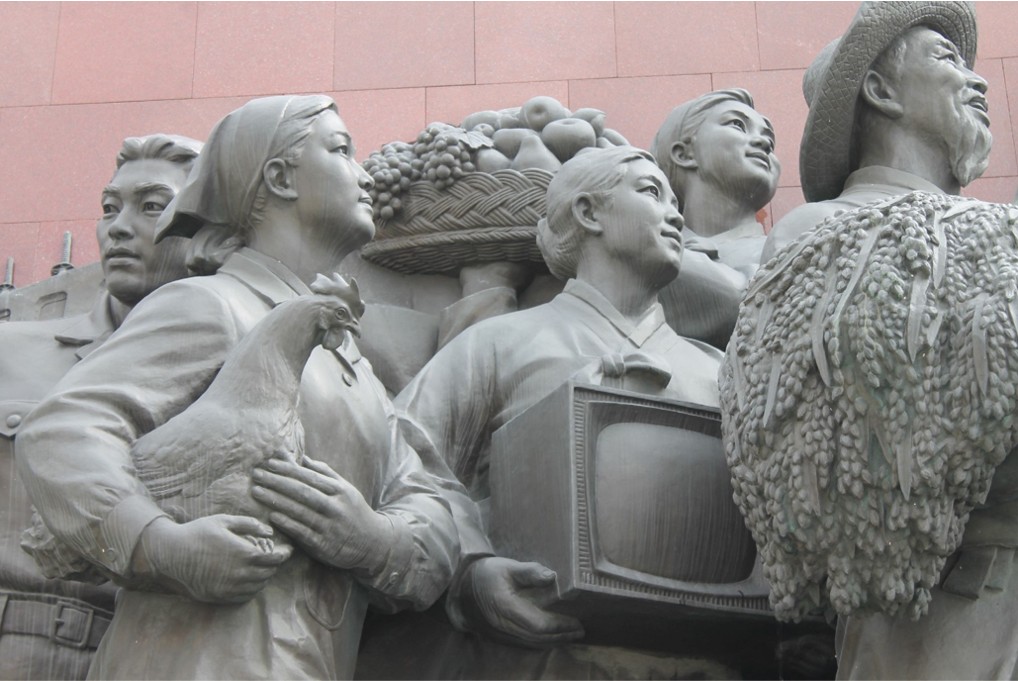
Another key function of North Korean art is to illustrate the nation’s progress. What might look, at first glance, like a woman running off with a television in Los Angeles is in fact a sculptural depiction of post-war recovery. Located in Mansudae, beside the monumental statues of the leaders, these large flanking sculptures celebrate the improvements in daily life: people carrying rice, chickens, and televisions — symbols of prosperity achieved after liberation from Japanese occupation.
This theme is expressed even more clearly in a 1970 ink painting by Ri Cheng. The work is a Chosunhwa, the traditional ink-and-brush style favored in the North. At the center is a television displaying the Chollima horse, the emblem of the national movement to rebuild the country at great speed. Through the window, electric lights illuminate the village — a sign of modern development. In the foreground, an elderly man wearing state-issued glasses hints at rising literacy rates. The accordion on the table reinforces the idea of family unity and hospitality, while the man resting his hand on it wears a wristwatch —another marker of progress. Each object is chosen deliberately, forming a dense network of symbols. As with many North Korean artworks, you can spend a long time uncovering the layers of meaning stitched into the scene; the narrative is deeply allegorical.
These visual strategies often feel familiar, echoing the didactic imagery many of us grew up with in biblical or moral illustrations. The overarching aesthetic is socialist realism, the dominant and almost exclusive artistic language in the country. There is landscape painting too — we’ll come to that — but most artworks aim to reshape and elevate reality. Smiles are amplified, gestures exaggerated, and everyday scenes transformed into visions of the “revolutionary reality,” the future the state wishes to project.
The leadership has always taken art seriously, recognizing its importance just as much as film. The guiding principle remains “national form, socialist content,” closely aligned with Soviet ideology. And while the imagery is idealized, it is always anchored in recognizable details, grounding the narrative just enough to make the revolutionary vision feel believable.
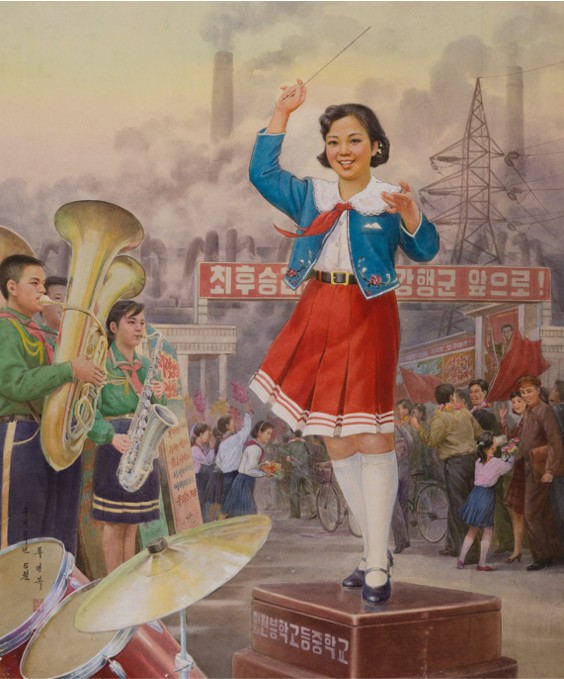
Juche 87, a small 1998 painting by Ryu Myong Bok, is a good example of how straightforward North Korean visual language can be. Bold characters immediately communicate the theme, in this case the Pyongyang thermal power plant. Moving closer, the details reveal an important aspect of everyday visual culture: the production boards that appear all over the country. These particular boards, shown outside the Chollima Steelworks near Nampo, track progress for example during 100-day and 150-day production campaigns. Workers encounter them at the entrance to the factory, school children encourage the workers with flowers, and plumes of smoke rise up in theair as a sign that the plant is working at full capacity.
Smoke is never hidden. In fact, it is often emphasized — a visible sign of industry in motion.Travelling around the country, you quickly learn that a belching chimney is not something authorities are worried about having photographed. Industry, quite literally, must be seen to be believed.
This painting takes that everyday reality and “turns up the dial” by about thirty percent, giving the finished image a heightened sense of purpose and energy.

And that leads directly into the question of training — where all this visual language begins.
North Korean artists are trained in an academic tradition rooted in European, particularly Italian, methods. At institutions like the Schoolchildren’s Palace and later the Pyongyang School of Fine Arts, students learn classical drawing techniques: model studies, chiaroscuro, and rigorous observational practice. Whatever one thinks of the system, these artists can genuinely paint. In an age when much contemporary art in the West moves away from technical foundations, this rigor stands out.
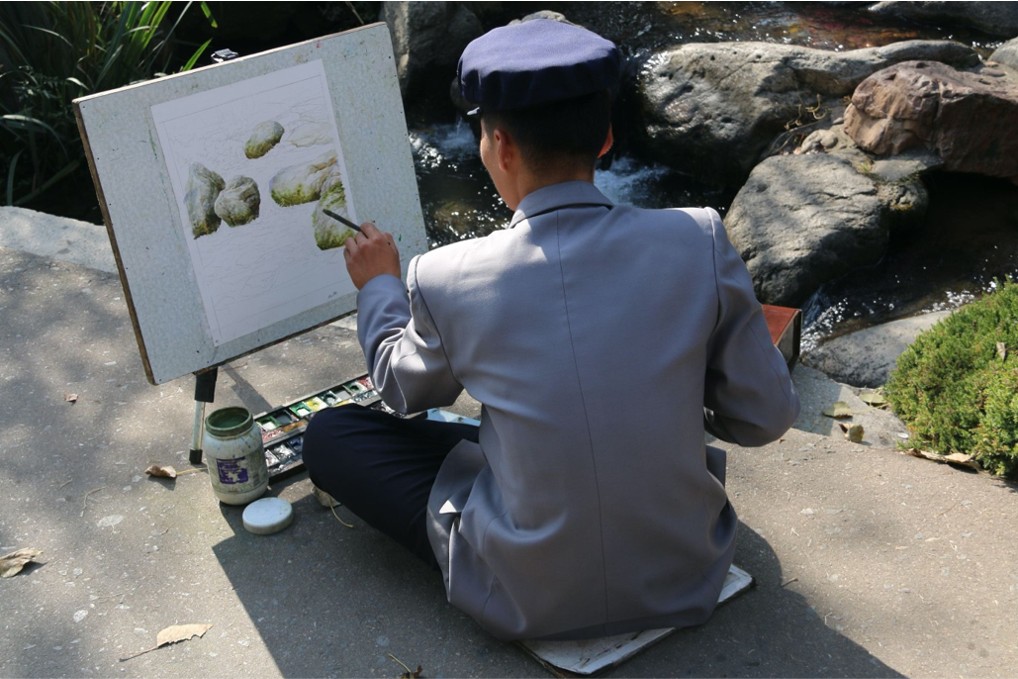
Landscape painting is a major part of university training. Students wear uniforms — men and women in the standard university attire— and alongside technique, they are taught the ideological and social purpose of art: what an artist represents within the revolution, and how art supports the state.
Those who excel may go on to work in one of the major art studios. Mansudae Art Studio, currently under sanctions, is the most well-known, but it is one of several studios in Pyongyang, with others located in provincial cities. Local teams produce posters and regional visual materials, but Mansudae and Paekho remain the most revered studios.
Inside these studios, the hierarchy of artistic production becomes very clear. Portraits of the leadership dominate the visual environment, reminding artists of their ultimate client: the state, inseparable from the leadership itself. Kim Jong-il articulated this directly when referring to Kim Il Sung. He wrote: “Socialist fine art is the most powerful means of highly praising the revolutionary exploits of an outstanding leader of the working class, and defending his absolute dignity and prestige.”
Many cultures use idealized imagery to reinforce belief or moral authority. North Korean art functions similarly: once an idea appears in painted form, its legitimacy feels reinforced.
Artists studying at Mansudae work in a college-like structure. Mornings begin with live drawing sessions, essential to maintaining technical discipline. Over time, artists are evaluated and ranked; those who achieve exceptional skill and ideological reliability are honored with titles such as Merited Artist or, at the highest level, People’s Artist.
This section offers a glimpse inside one of the major studios. The work shown here was originally commissioned for a project in Australia at the Asia–Pacific Triennial. The studio itself is shared by two or three artists — a sign of advancement, since those earlier in their careers often work in far more crowded conditions. Artists who truly excel eventually receive their own studio, along with practical advantages such as improved housing and better access to food. These incentives are not primarily financial; they are part of a system that rewards skill, diligence, and ideological reliability.
The process behind these paintings is remarkably meticulous. Each work begins with a small sketch, followed by a larger preparatory drawing in pencil and charcoal. Only once the composition is perfected do artists transfer it again — this time without pencil lines — so that when ink is applied, the finished painting shows no trace of underdrawings. It is a painstaking method, rooted in tradition and discipline.
The paintings are executed on chamji, a mulberry paper produced directly inside the studio. The sheets shown here are the largest they can manufacture, and several were created specifically for the exhibition. The artist’s lapel badge reads Mansudae Art Studio, a reminder that, despite their skill and individuality, these are fundamentally worker-artists. Their role is to depict the world within the boundaries of a state ideology. Those boundaries may loosen later in an artist’s career, allowing for more personal expression, but early on they are expected to follow assigned themes and carry out directives from above.
Artists regularly travel to the countryside in groups to sketch and gather material. Over time, they gradually develop their own artistic signatures. But the subjects they tackle often originate directly from leadership speeches. If the leader highlights the importance of a major factory — the Steelworks, for instance —artists are expected to visit and paint it. In such years, a notable concentration of Steelworks paintings appears. There is some room for artistic freedom, and it increases with age and seniority, but the system remains clearly structured.
Among those who managed to cultivate a distinctive voice was the late Son U Yong. He developed a deeply individual landscape style and even exhibited in South Korea — a rare achievement. His work demonstrates how, even within a tightly regulated environment, artistic identity can emerge.
Another example is Kim Sung Hui, a Korean artist born in Japan who relocated to North Korea with her family in the 1960s — a story that deserves its own space. She is one of the few female painters working in ink. In North Korea, women artists often gravitate — or are channelled — into embroidery, while painting remains largely male-dominated. But exceptions exist, and Kim Sung Hui is one of them.
Among the most important works produced each year are the ink paintings — Chosunhwa —often referred to as Juche-themed art. Every artist is required to create one major ideological piece annually, effectively a contribution to the state. Many of these works draw on the long tradition of Korean ink painting, linked historically with elements of Chinese shanshui. The result is a visual language that feels both historical and politically charged. Even the inclusion of an azalea, for instance, carries symbolic weight: it is the flower said to have bloomed when Kim Il-sung and his guerrilla fighters returned from Manchuria. Allegory is never accidental in these works; it is embedded into every detail.
Although ink is often considered the strongest medium in North Korea, oil painting also has a significant presence. Many pieces show impressive technical mastery, though my own focus tends to be on ink works for their extraordinary nuance.
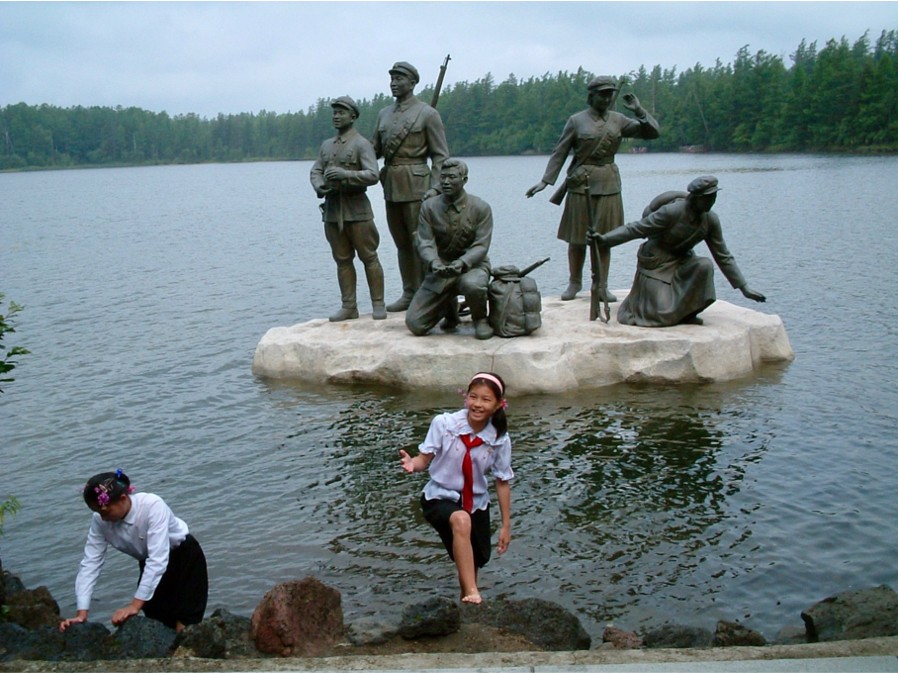
Large-scale mosaics are another defining feature of public art in North Korea. The country’s extreme climate — bitter winters and humid summers — makes mosaics ideal for outdoor monuments. Pyongyang is filled with them, monumental and immovable. Sculpture, too, is integral to the visual landscape: the piece at Samjiyon, near Mount Paektu, depicts one of the girls featured in A State of Mind. These works often appear in parallel forms — a sculpture accompanied by a corresponding woodblock print — to reinforce a single theme across different mediums.
Woodblocks and linocuts are perhaps best represented by the late Hwang In-jae. One of the finest printmakers of his generation, he created work of remarkable clarity and power. Over the years of commissioning art — month after month, visit after visit — I came to know artists like him personally. When you return every two months, you meet their families, share meals, and build relationships, even within the constraints of the system. There are countless stories there.
When we turn to abstraction, the contrast is stark. Kim Jong-il famously insisted that “a picture must be painted so that it can be understood,” which effectively excludes abstract art. Clarity, narrative, and legibility are essential. The slightly abstract style of an early artists like Pai Un Song — born underJapanese occupation in the south of the country who defected to the north after the Korean War, are now undergoing a kind of rediscovery in the South — is something that would not be permitted today. His work, like that of several artists who travelled north, has only recently begun to receive recognition.
Even within institutional settings, art is treated carefully. In one of the Schoolchildren’s Palaces, a painting is kept cool with its own electric fan —even if the children are not. And this small detail says something about hierarchy. In fact, there is a strict hierarchy in subject matter, determined by the Korean Artists’ Federation: first the leaders, then revolutionary history, followed by major infrastructure projects. For many years, unification was also a central theme. But that the notion of unification has largely vanished from public discourse — and in the North, its disappearance has been literal and physical. The enormous Arch of Reunification that once spanned the reunification highway has been torn down. We are, in every sense, living in interesting times.
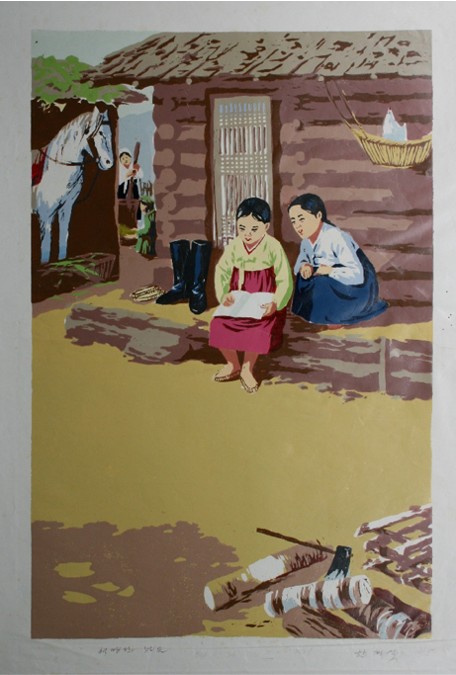
In 2009, an entire exhibition was dedicated to celebrating the achievements of Kim Jong Il. It consisted largely of paintings showing him offering on-the-spot guidance, visiting factories, speaking with workers, and touring rural areas. Alongside these were works focused on Kim Il-sung, recognizable through familiar symbols: the military boots, the young girl recording stories of resistance against Japanese occupation, the literacy campaigns, the ever-present army, and, of course, the white horse. For a North Korean audience, the meaning is immediate and unambiguous.
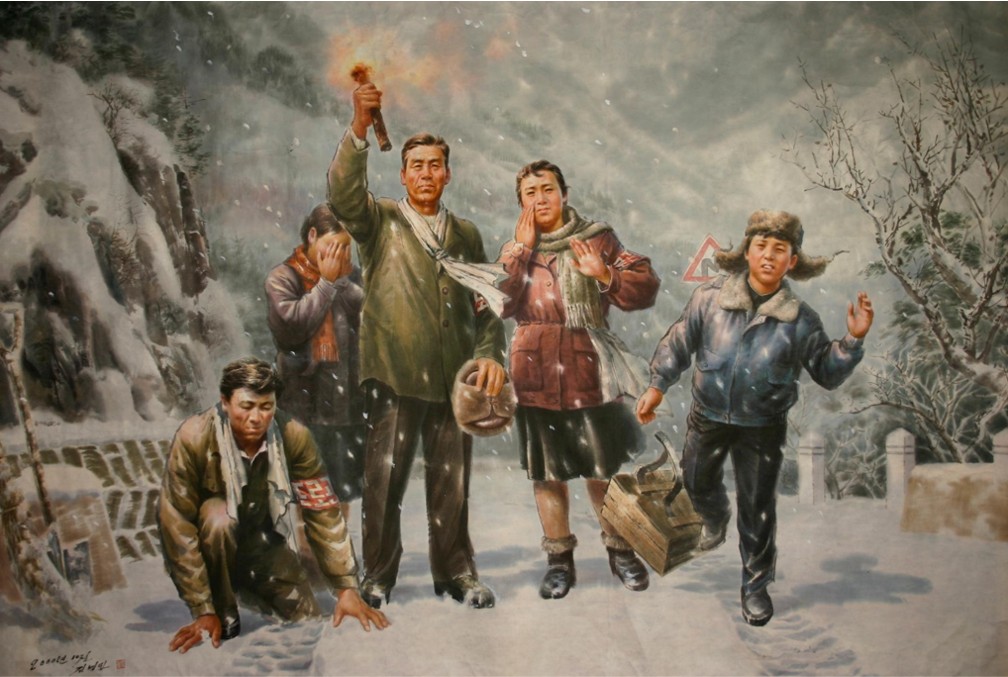
A later painting shows Kim Jong Il shortly after leaving a village he has visited. The torch in the foreground evokes a range of state-sanctioned imagery — from revolutionary fire to the torch of Juche. In the distance, a young boy runs after the departing car, a sentimental gesture of devotion. Even the winding mountain road becomes part of the narrative, picked out with the sort of road sign that emphasises its symbolic journey rather than its geography. It all communicates a single message: the affection of the people for their leader.
Other works appear, at first glance, to be pure landscape. One serene winter scene, beautifully rendered, reveals its true subject only when examined closely: carved into the tree trunks is anti-Japanese graffiti, tying the image back to the guerrilla struggle. A linocut depicting mass mobilization celebrates the construction of the road from Pyongyang to Nampo — a project completed during the “Arduous March,” the years of severe famine and hardship in the 1990s and early 2000s. In the artwork, the struggle becomes triumph, the rough reality transformed into a story of collective achievement.
Reunification once formed a major thread in state art. There was a time when images of South Koreans secretly admiring the North or embracing shared ideals were common—sometimes unintentionally amusing, as in the depiction of a girl in unmistakable Adidas sportswear. But such imagery has all but disappeared. The political climate shapes what can and cannot be painted.
Landscapes, however, continue to flourish, especially in the hands of artists like Sonu Yong, whose work brought a distinctive lyricism to the genre.
This leads naturally to the question of artistic practice — and what it means to “become an artist” in North Korea. The most important principle is that art is not an individual pursuit. It is collective. The subject matter is predetermined, and almost all works fall into recognizable categories: the nation, daily life, harvests, major construction projects, mining, fisheries, scientific advances. Individual sketching trips to the countryside are part of artistic development, but the finished works are collective in purpose, always oriented either toward the future of the revolution or toward the struggles of the past.
If one were to summarize the visual formula: abundance, modern equipment, harmonious labour, perhaps an accordion to signal community spirit, and smiling faces everywhere. Rice planting becomes fully mechanised, landscapes are orderly, and the breeze blows just right. And, woven throughout, what might be called “pastoral nationalism” — a carefully crafted image of an ideal countryside embodying the values of the state.
Natural landscapes and seascapes often serve a dual purpose in North Korean art: they celebrate the beauty of the country while asserting the idea of national independence. Even scenes of everyday life are folded into this narrative. A girl tending goats, students returning from the goat farm, workers heading toward the rice fields — all appear cheerful, embodying the collective spirit. Teamwork is central: one is never an isolated individual but part of a larger whole. Labour becomes a source of pride, and daily tasks are portrayed with an almost festive energy.
Even routine chores take on symbolic meaning. A group of young women pushing a street-cleaning machine stands for the joy of serving the state and its people. The tone is deliberately optimistic, presenting ordinary life as harmonious and full of purpose.
Stylistically, these scenes draw on a stoic, theatrical vocabulary. As in North Korean film —such as Kim Goes Flying — gestures are often exaggerated, heroic, and slightly idealised. Artworks depicting competition or physical strength follow the same approach: a young woman winning an arm-wrestling match against a man, for example, conveys both empowerment and ideological lesson.
Infrastructure projects are another recurring theme. The construction of the Nampo Highway or the May Day Stadium is shown through bold compositions accompanied by clear slogans, ensuring the message is understood at a glance. In one telling scene, a young worker receives a bouquet from a beautiful woman; behind him stands a train marked with red stars signifying accident-free kilometres, while an elderly figure — almost in a Confucian gesture — offers him respect. Every element reinforces his status as a model citizen.
Yet depicting an individual is always carefully controlled. Only certain figures may truly stand alone, and these are invariably the leaders. In most cases, the “individual” serves as a stand-in for the collective. Characters must embody wholesomeness, health, virtue, and loyalty. If the artist makes a considered choice of focusing on an individual he or she will be and appealing, attractive figure receiving adulation- glowing with wholesomeness as if they wer following an ascetic life-this is perhaps because beauty is both consciously and unconsciously linked to goodness, health and therefore success.
Even when one person appears at the centre of the composition, it is understood that they represent their entirework unit. Heroism is never solitary; it is shared, and every achievement belongs to the team.
The question of individuality is central to understanding how North Korean art functions. One of the most striking insights offered by artists themselves is the idea that individuality is not simply discouraged — it is intentionally absorbed into the collective. Cohesion, collective power, and the clear division of labour are all framed as virtues that stand above personal expression. As artists describe it, the strength of the group grows while individualism gradually recedes. This principle underpins the entire aesthetic system.
Art becomes the mechanism through which society assigns roles and celebrates heroism in everyday life. Even the most ordinary worker — a factory hand, a driver, a woman on a production line — is elevated through representation. Their labour is portrayed as indispensable to the nation’s progress. In this sense, the art serves a purpose similar to Victorian social realism in Britain, though with a distinctly socialist interpretation: dignity is granted by one's contribution to the collective, not by personal aspiration.
A small detail from two nearly identical images illustrates how meaning is encoded. One scene depicts a fish farm, the other a goat farm. At first glance they seem the same, but the newspapers held by the workers reveal the difference: in one, the paper is carried casually; in the other, held with greater respect as it bears the Leader’s name. These minute distinctions — easy to miss — are exactly the kind of clues art historians look for when tracing ideological nuance.
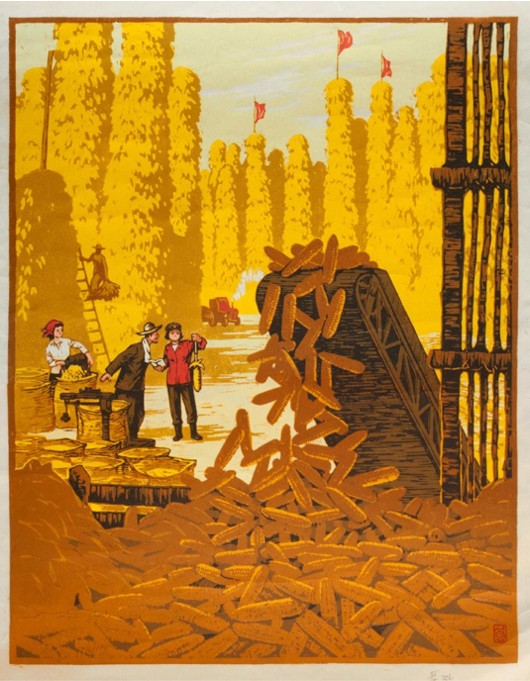
Props also play an essential role in constructing meaning. In linocuts and paintings alike, each figure is linked to their task: a worker polishing metal, a technician tending machinery, a farmer inspecting a wind farm. Regardless of medium — ink, oil, linocut — the themes remain remarkably consistent: rice heavy on the stalk, corn abundant, landscapes flourishing. Works produced a decade apart often convey the same reassuring message of prosperity and order.
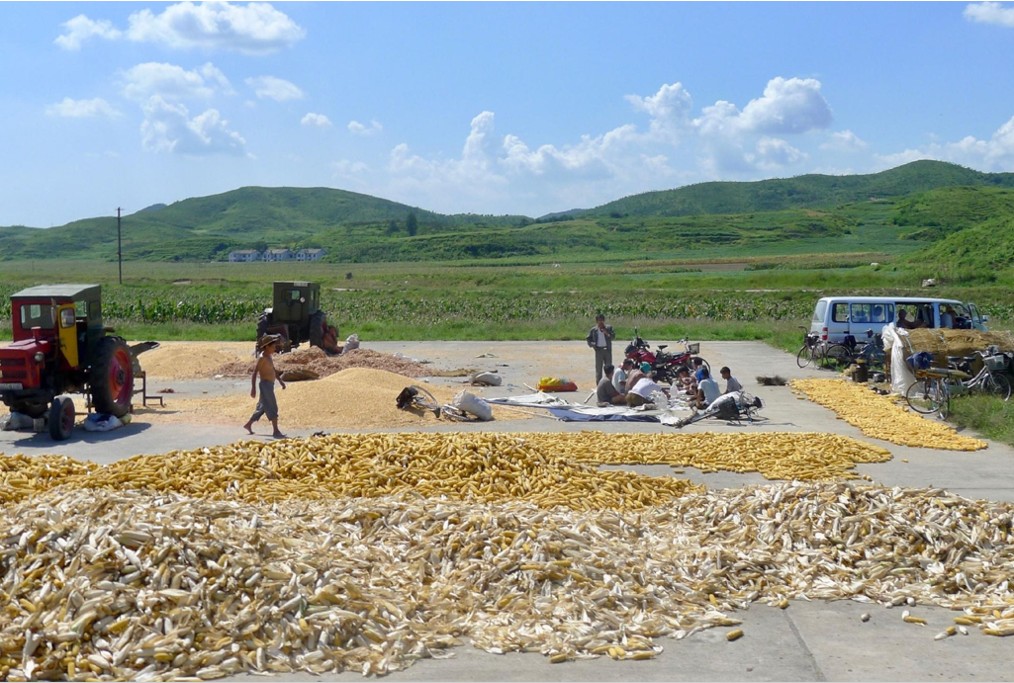
During the Songun, or “Army First,” period, similar imagery extended to the military: soldiers assisting with rice planting and harvests, reinforcing the idea of unity between army and people. Yet occasionally, glimpses of reality surface. A linocut showing a “good harvest” contrasts starkly with the actual conditions on the ground. Another painting from the early 2000s depicts terraced hillsides— a practice that became widespread only after years of hardship forced the cultivation of every available patch of land. Rarely, a piece even carries a subtle admonition: do not waste.
Some of the most revealing moments emerge when official representations sit side by side with glimpses of everyday life. A small linocut of May Day festivities in Taesong Park captures that delicate boundary where propaganda must remain believable. Joyful scenes of workers smiling at their tasks echo the universal tension between representation and reality — a tension hardly unique to North Korea. As in many cultures, when the camera appears, people straighten up and smile. The picture tells one story; lived experience may tell another.
This, then, is North Korean art as you’ve now seen it. And when you encounter it, this is essentially what you face. It inevitably raises a question: is this art? Can we meaningfully speak of “art” within a system in which individuality is subsumed, where subjects and aesthetics are prescribed, where the purpose of imagery is tightly controlled?
In the West, we expect art to emerge from individual expression. But if we look further back —to the eras of papal commissions, aristocratic patronage, or state ateliers —the idea that all art must be personal and autonomous is a relatively new one. So again: do we trust these artists? Are they simply reproducing a political message?
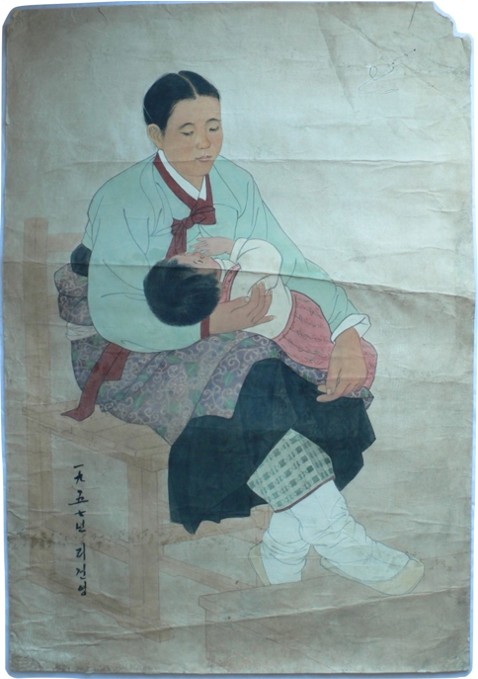
We can discuss all this. But for me, the answer is an unequivocal yes. And here — as Monty Python would say — comes “something completely different.” Because while the official line insists, as Kim Jong Il put it, that “art not related to the revolution is useless,” we nonetheless encounter works that are unmistakably individual. Quietly, privately made, often kept in artists’ homes— pieces that reveal the people behind the system.
Many of these artists originally came from the south of Korea (under Japanese occupation). When the country was divided, they found themselves in the North — some by choice, others through far more complicated circumstances — drawn by the promise of a utopian “people’s paradise.” Within their private work, humanity resurfaces.
Here is a small piece from 1964 — a domestic scene, modest, tender. A completely different colour palette; an experiment, an artist trying something new. They may be sketches or studies, but they are deeply personal.
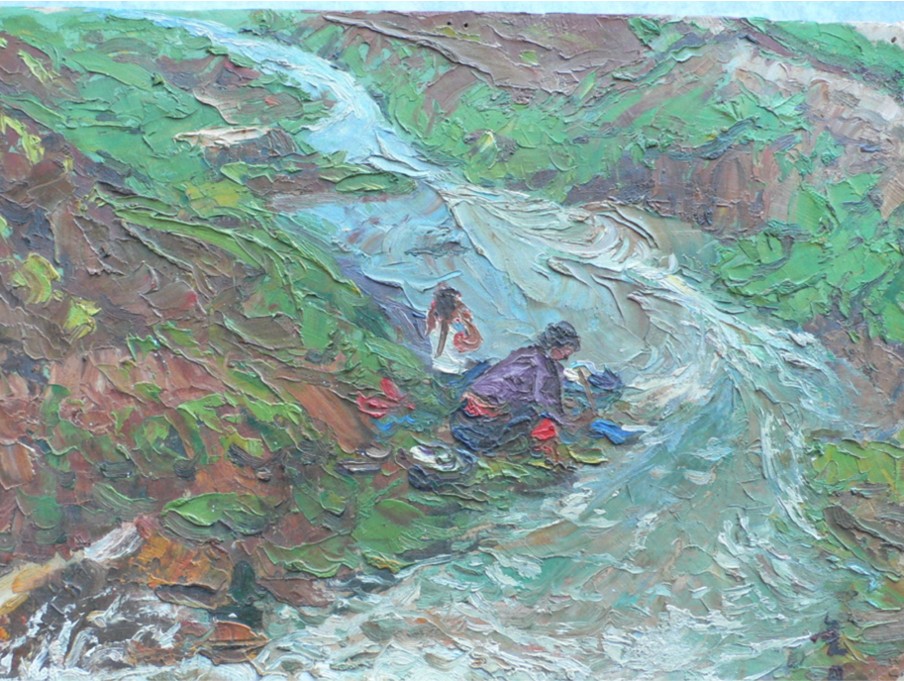
An artist I adore, Mr. Hong Jong Won, worked with a palette knife. He trained under Pyon Song and Lee Qoede. His intimate scene — a mother and daughter — is extraordinary. You can almost feel the plaits in the girl’s hair. She is washing, while the mother beats the clothes clean with a stick. A quiet, beautifully observed moment.
On the back of a full-size painting by Hong Jong-won (1928–2004) you find the first sketch. Seeing both together is extraordinary — the privilege of holding a work alongside the artist’s initial thought. This is how I’ve come to know these pieces: by living with them, for now, until we can determine their future with a more academic approach.
And then there are works I’m still trying to understand. This painting, for instance: I have no idea what is really happening. The early sketch shows his first intention —before he realised the composition didn’t quite work. The woman behind the tree, the man watching — they form a kind of unit. But in the finished work, although the structure remains similar, the emotional tension shifts completely. The palette work, the colour — this is 1983 — it’s extraordinary.
What this reveals is the dual life of North Korean art: the academic socialist-realist production on one hand, and these deeply personal experiments on the other. Hong was a master painter — and here he is doing something private, intimate, and astonishing.
We produced a couple of books of linocuts, including one for Phaidon. Among a group I acquired was a small print. On the back is written, simply, “Memories of the Girl.” It’s clear that someone was in love — remembering a woman, perhaps his wife, perhaps someone else entirely. It is delicate, intimate, human.
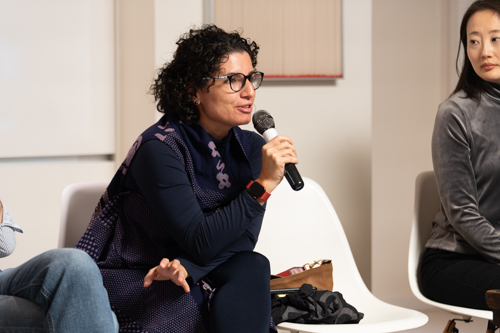
"This, then, is North Korean art as you’ve now seen it. And when you encounter it, this is essentially what you face. It inevitably raises a question: is this art? Can we meaningfully speak of art within a system in which individuality is subsumed, where subjects and aesthetics are prescribed, where the purpose of imagery is tightly controlled? We can discuss all this. But for me, the answer is an unequivocal yes."
All the pictures from The Talk's presentation are courtesy of Nicholas Bonner.
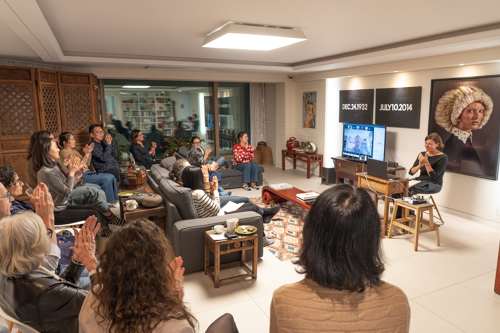
Thanks to those who joined in person and online, and to the many connecting nodes who actively helped spread the word about this event - with a special mention to Belesì, that connected from Italy with its enthusiastic audience.

.jpg)